

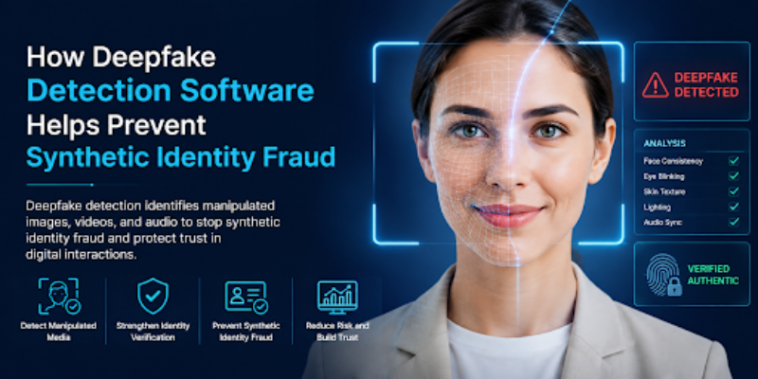
Synthetic identity fraud is becoming more difficult to detect as artificial intelligence enables criminals to create convincing digital identities. Instead of simply stealing an existing identity, fraudsters can combine genuine and fabricated information to construct identities that appear legitimate during online verification.
Deepfake detection software can help organizations address one part of this threat by identifying manipulated or artificially generated images, videos, and other biometric media. When combined with liveness detection, facial recognition, document verification, and risk analysis, it can strengthen defenses against synthetic identity fraud.
The Growing Risk of Synthetic Identity Fraud
Synthetic identity fraud differs from traditional identity theft. Rather than completely impersonating an existing individual, an attacker may combine real information with fabricated details.
For example, legitimate personal information could potentially be combined with a synthetic photograph or manipulated video to create a digital identity that appears authentic.
This creates challenges for businesses that rely on remote onboarding and biometric verification. A valid-looking identity document or realistic facial image does not necessarily prove that the person behind the interaction is genuine.
Where Deepfake Detection Fits
Deepfake detection software analyzes digital media for patterns that may indicate artificial generation or manipulation.
Depending on the system, AI models can examine facial characteristics, image texture, video frames, lighting, movement, and other technical signals.
During identity verification, the software can analyze submitted images or videos and provide an assessment of whether the media contains characteristics associated with manipulation.
It therefore adds an additional security layer to the verification process.
Detecting Synthetic Facial Media
Synthetic faces can be generated or modified using AI-based tools. These images may be used to create false profiles, support fraudulent applications, or manipulate biometric verification processes.
Deepfake detection can examine facial media for inconsistencies that may not be obvious during manual inspection.
For businesses, this can help identify suspicious biometric evidence before it becomes part of an approved identity record.
Combining Deepfake Detection With Liveness Detection
Deepfake detection and liveness detection address related but different risks.
Deepfake detection focuses on whether digital media has been artificially generated or manipulated. Liveness detection focuses on whether a real person is physically present during the biometric interaction.
Using both can create stronger protection.
For example, a verification workflow may assess whether a user’s face matches an identity document, whether the person is physically present, and whether the captured video shows signs of synthetic manipulation.
Multiple signals can provide more confidence than relying on facial matching alone.
Supporting Facial Recognition Verification
Facial recognition can compare a user’s facial characteristics with a trusted reference, such as a photograph from an identity document.
However, the quality and authenticity of the submitted image matter. If manipulated media is used as input, facial matching alone may not provide sufficient assurance.
Deepfake detection can complement facial recognition by assessing whether the facial media itself appears authentic.
This creates a layered process in which one technology evaluates identity similarity while another examines potential media manipulation.
Strengthening Digital Onboarding
Online onboarding is particularly vulnerable to synthetic identity fraud because customers can complete verification without meeting an employee in person.
A stronger onboarding process can combine document verification, facial recognition, liveness detection, and deepfake analysis.
If the submitted information appears inconsistent or suspicious, the organization can request additional verification or route the case for manual review.
This approach can reduce dependence on a single automated decision.
Protecting Financial Services
Financial organizations have a strong incentive to detect synthetic identities because fraudulent accounts can potentially be used for unauthorized transactions, financial crime, or other abusive activity.
Deepfake detection can support identity checks during account creation and selected high-risk transactions.
It can also contribute to risk-based systems that consider multiple signals before approving an application.
The technology does not eliminate fraud by itself, but it can strengthen the biometric and media-analysis components of a broader fraud prevention strategy.
Using AI to Identify Subtle Manipulation
One advantage of AI-based detection is its ability to analyze large numbers of technical characteristics simultaneously.
A detection model may examine patterns across multiple video frames rather than relying on a person to identify visual inconsistencies manually.
This can help organizations process large verification volumes while maintaining automated screening.
However, model performance depends on factors such as training data, detection architecture, media quality, and the ability to recognize newly emerging manipulation techniques.
A Layered Approach to Synthetic Identity Prevention
Deepfake detection is most effective when combined with other controls. A comprehensive identity security workflow may include:
- Identity document verification
- Facial recognition
- Liveness detection
- Deepfake detection
- Device intelligence
- Behavioral analysis
- Risk scoring
- Manual review for high-risk cases
Each layer addresses a different part of the identity verification problem.
If one signal is uncertain, additional signals can provide context before the organization makes a final decision.
Challenges Businesses Should Consider
Deepfake detection is not a perfect solution. Generative AI continues to evolve, meaning new manipulation methods may emerge faster than existing detection models can adapt.
Poor camera quality, compression, lighting, and network conditions can also affect analysis.
Businesses should therefore test detection systems under realistic conditions and monitor false acceptance and false rejection rates.
Regular model evaluation and updates are important for maintaining effective protection against changing attack methods.
Protecting Biometric and Identity Data
Synthetic identity prevention often requires processing sensitive information. Businesses must therefore consider privacy and data security throughout the verification lifecycle.
Organizations should collect only necessary information and establish appropriate controls for storage, processing, access, and deletion.
Strong encryption, restricted access, data minimization, and clear retention policies can help reduce unnecessary exposure.
Security measures should also be aligned with applicable privacy and data protection requirements.
The Future of Synthetic Identity Prevention
As generative AI becomes more capable, synthetic identity prevention will increasingly depend on multiple forms of intelligence.
Future verification systems may combine deepfake detection with liveness detection, facial recognition, document analysis, device intelligence, behavioral signals, and real-time risk assessment.
The objective will be to evaluate the entire identity interaction rather than relying on one piece of evidence.
Organizations will increasingly need to determine whether the submitted identity information is consistent, whether the user is genuine, and whether the digital media has been manipulated.
Conclusion
Deepfake detection software can help prevent synthetic identity fraud by identifying potential manipulation in images, videos, and biometric media used during digital verification. Its greatest value comes from working alongside other identity security technologies.
Combining deepfake detection with facial recognition, liveness detection, document verification, device intelligence, and risk-based authentication can create a stronger defense against sophisticated identity attacks.
As synthetic media continues to evolve, businesses will need adaptable, layered verification systems that can evaluate not only the information a user provides but also the authenticity of the digital evidence supporting that identity.